A Place for Truth: Leading Thinkers Explore Life's Hardest Questions by Dallas Willard
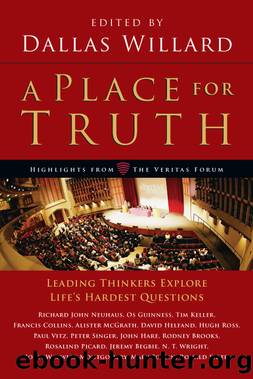
Author:Dallas Willard [Willard, Dallas]
Language: eng
Format: epub
Publisher: InterVarsity Press
Published: 2010-08-03T00:00:00+00:00
Arguments Against God as Basis for Morality
But why would anyone think that you canât say acts are morally wrong without the existence of God? Iâm going to mention three distinct reasons, three distinct grounds why some theists have suggested we canât say this.
1. Right and wrong are arbitrary. The first claim is that the terms right and wrong are meaningless unless you believe in the existence of God. Theyâre said to be meaningless because something is right only because God wills it or commands it, and wrong only because itâs contrary to his will. So the very meaning of the moral terms, some theists say, is bound up with the idea of a God who gives meaning to these terms by his commands.
The standard response to this is what is known as the Euthyphro argument, coming from Platoâs dialogue of that name, and I must admit Iâm a little tentative about discussing the Euthyphro with somebody whoâs written a commentary on it. I am certainly not a scholar of Plato or of the Euthyphro. So if I get some of the actual argument out of its context, Iâm ready to stand corrected. But the important point of the argument seems to be this: if we say that right and wrong are meaningless without God, we have to say whether itâs the case that something is right only because God wills it and wrong only because itâs contrary to his will, and then this means that if God had willed something different, then different things would be right and wrong. So if God had willed us to torture babies, then it would be right for us to torture babies. And if God had willed us not to help the weak and vulnerable, then it would be wrong for us to help the weak and vulnerable.
We might say, of course, that God is the God of love, and God could not have willed that we torture babies and donât help the weak and vulnerable, but to say that suggests that we already have a notion of what is good. Perhaps weâre saying that love is good and that the loving act is a good act to perform, but then this claimâthat love is goodâis independent of what God wills.
So this is the dilemma that we face: either there is no notion of right and wrong independent of God, and God could have willed us to do things differently, and they would then have been right or wrong, or God wills these things because they are good, but then we have to have the idea that there is some notion of good independent of God.
Thus, it doesnât seem to me that we can say the very terms good and bad are meaningless without God, at least not unless weâre prepared to bite the bullet on this claim that God really was making an arbitrary decision in choosing to command us to help the weak and vulnerable, rather than in choosing to command us to kick them when theyâre down.
Download
This site does not store any files on its server. We only index and link to content provided by other sites. Please contact the content providers to delete copyright contents if any and email us, we'll remove relevant links or contents immediately.
The Art of Coaching Workbook by Elena Aguilar(51221)
Trainspotting by Irvine Welsh(21690)
Twilight of the Idols With the Antichrist and Ecce Homo by Friedrich Nietzsche(18642)
Fangirl by Rainbow Rowell(9262)
Periodization Training for Sports by Tudor Bompa(8278)
Change Your Questions, Change Your Life by Marilee Adams(7788)
This Is How You Lose Her by Junot Diaz(6894)
Asking the Right Questions: A Guide to Critical Thinking by M. Neil Browne & Stuart M. Keeley(5779)
Grit by Angela Duckworth(5623)
Red Sparrow by Jason Matthews(5479)
Paper Towns by Green John(5196)
Room 212 by Kate Stewart(5130)
Ken Follett - World without end by Ken Follett(4740)
Housekeeping by Marilynne Robinson(4455)
The Sports Rules Book by Human Kinetics(4398)
Papillon (English) by Henri Charrière(4278)
Double Down (Diary of a Wimpy Kid Book 11) by Jeff Kinney(4278)
The Motorcycle Diaries by Ernesto Che Guevara(4106)
Exercise Technique Manual for Resistance Training by National Strength & Conditioning Association(4076)
